• Assurance of Clinical AccuracyReliable measurement accuracy is essential for clinicians to accurately assess a patient’s oxygenation status. LowPulseStr® arterial oxygen saturation technology has undergone rigorous clinical validation conducted by the International Hypoxia Laboratory (HLSZU), and its performance has been documented in clinical reports approved by the FDA, CE, and NMPA.The clinical evaluation was carried out on healthy adult volunteers who underwent controlled hypoxia testing. During the study, arterial blood samples were collected at regular intervals via an arterial catheter across multiple stable oxygen saturation phases. These samples were analyzed using a CO-oximeter to determine arterial oxygen saturation (SaO₂), which served as the reference standard.Simultaneously, pulse oximeter readings (SpO₂) were obtained using the LowPulseStr™ technology. Comparative analysis between the SpO₂ values and the reference SaO₂ values was conducted. The resulting SpO₂–SaO₂ dataset was subjected to statistical analysis, yielding a clinically accepted validation report confirming the accuracy and reliability of the technology, as illustrated in the figure below.

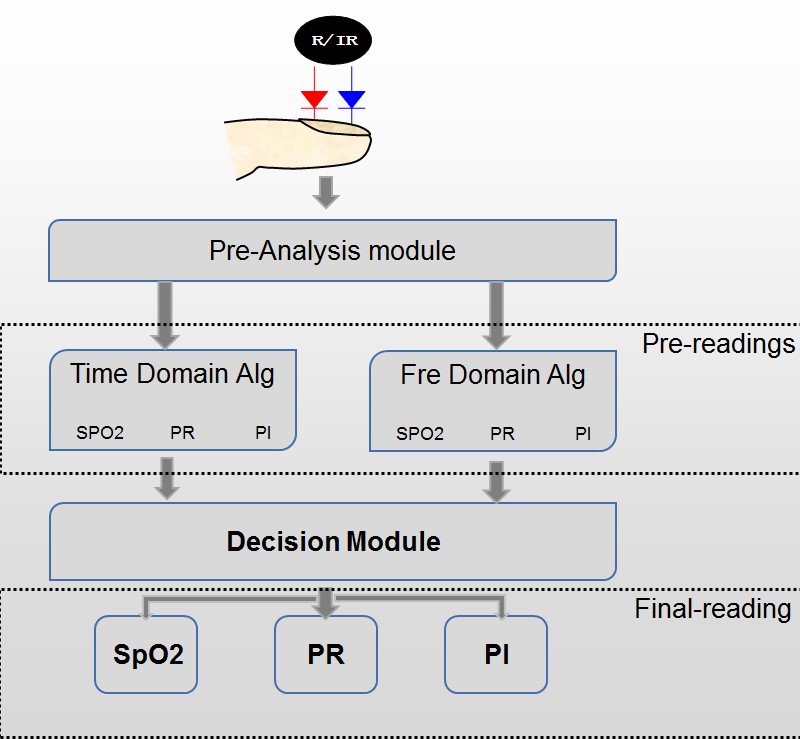
• Multi-Computing Engine and Anti-Interference TechnologyLowPulseStr® arterial oxygen saturation technology incorporates a tri-engine architecture, consisting of time-domain, frequency-domain, and decision-based algorithms to ensure high accuracy and reliability across a variety of clinical scenarios.·The time-domain algorithm is characterized by its real-time processing capabilities, delivering rapid SpO₂ calculations across diverse monitoring conditions. Its primary objective is to provide healthcare professionals with fast and accurate pulse oximetry readings for immediate clinical reference.·The frequency-domain algorithm offers strong anti-interference performance, making it particularly effective in complex clinical environments such as emergency care and neonatal monitoring. By filtering out motion artifacts and environmental noise, it enables reliable measurement results and supports clinicians in making precise assessments of patient status in challenging conditions.·The decision algorithm serves as an intelligent, autonomous evaluator of the final output. It integrates results from multiple physiological indicators and computational engines to deliver an optimized judgment, improving the accuracy of arterial oxygen saturation measurements and minimizing the risk of measurement failure in clinical applications.This multi-layered computing strategy is illustrated in the following figure, demonstrating how LowPulseStr® enhances measurement robustness and clinical reliability.
• Broad Clinical ApplicationLowPulseStr™ integrates wide-range measurement technology, significantly enhancing SpO₂ measurement accuracy across diverse patient populations and clinical conditions. Its adaptive multi-position gain control enables rapid optimization of signal quality upon entering the measurement state. Through dynamic gain switching via a multi-channel architecture, the system maintains optimal detection performance regardless of patient variability.This technology ensures high measurement reliability across a broad spectrum of skin tones— including light, medium, and dark pigmentation—as well as across various anatomical monitoring sites such as the forehead, earlobe, nose, fingers, and toes. Its versatility supports accurate oxygen saturation monitoring in neonatal, pediatric, and adult patients, meeting the demands of a wide range of clinical environments.